Squat: When Shallow Water Pulls the Ship Down
In shallow water the flow accelerates under the hull and pressure drops — the ship sinks bodily and trims, full forms by the bow and fine forms by the stern. Why squat is a resistance problem, not just a safety margin.
A 180,000 DWT tanker doing 10 knots in a channel with a depth-to-draft ratio of 1.2 can squat by over 1 meter. That's the difference between safe under-keel clearance and a grounding incident.
Most operators know squat exists. Very few have a working solution for it. The pilot's table gives an estimate — typically a rule of thumb like the Barras formula or a simplified empirical lookup. That's sufficient for passage planning. It's not sufficient for understanding why your power demand in a shallow channel doesn't match your deep-water performance curve.
Squat is not only a safety-margin issue. It is a hydrodynamic resistance issue that directly affects performance — the first of the five shallow-water effects this series maps.
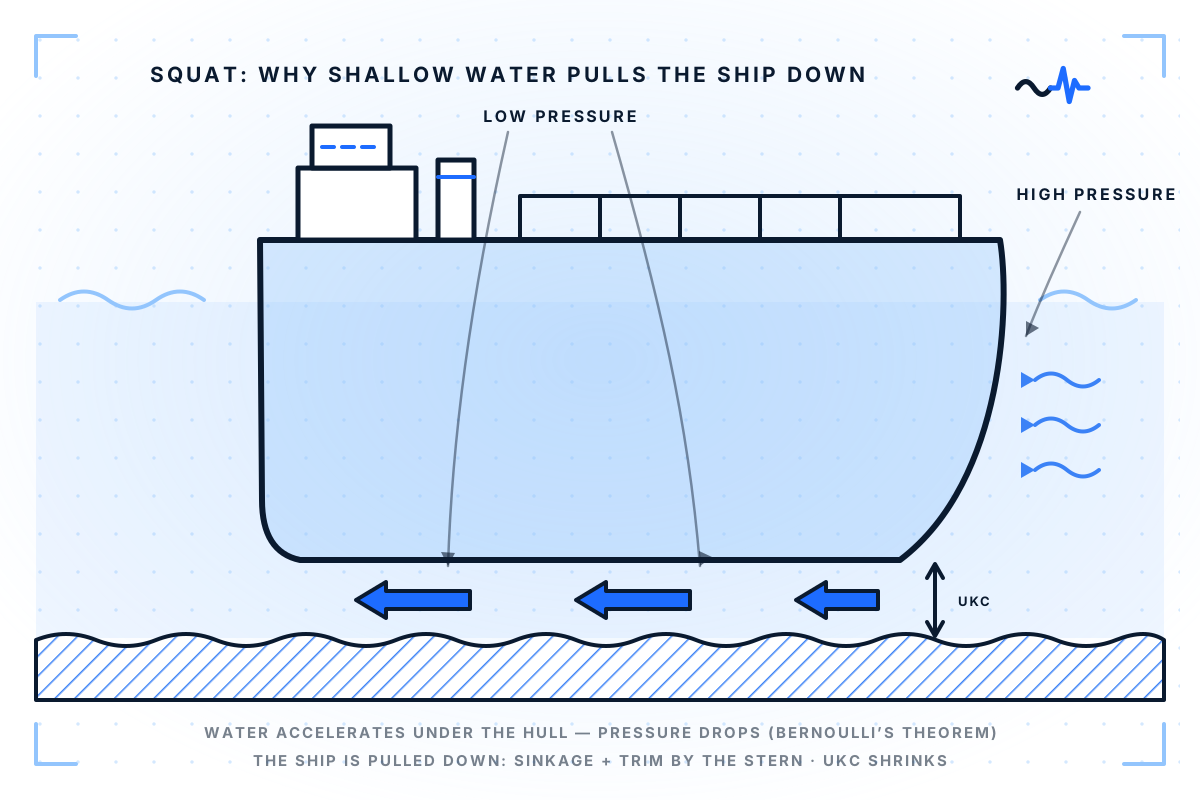
The mechanism
When a vessel moves through shallow water, the cross-sectional area available for water to pass beneath and around the hull is restricted. To satisfy continuity, the flow accelerates. Faster flow means lower pressure — and lower pressure beneath the hull means the vessel is pulled downward.
The result has two components:
- Sinkage — the vessel drops bodily, reducing under-keel clearance uniformly along its length.
- Trim change — the pressure distribution shifts fore and aft and the vessel trims. Which end goes down depends on hull form, and Barrass's rule from the full-scale record draws the line at a block coefficient of about 0.7: full-form ships above it (tankers, bulk carriers) trim by the bow, fine-form ships below it (container and passenger ships) trim by the stern, and near 0.7 the squat is almost pure sinkage. Only close to the critical speed does every hull, full or fine, go down by the stern. For a laden tanker in a channel it is the bow that needs the clearance.
The magnitude of squat scales with:
- Speed squared — double the speed, quadruple the squat
- Block coefficient — full-form vessels squat more than fine-form ones
- Depth Froude number (Fr = V / √(g·h)) — as Fr approaches 0.7–0.8, squat increases sharply
- Channel blockage ratio — the ratio of the submerged hull cross-section to the channel cross-section
The backflow effect compounds this: the water displaced by the hull has to go somewhere. In open water it returns around the hull. In a confined channel, it travels backward along the hull at increased velocity, generating a pressure gradient that further increases resistance and affects the stern wave.
Why it matters for performance monitoring
At Fr = 0.7 in a confined channel with a blockage ratio above 0.15, the combined squat and backflow resistance increase can be significant enough to shift your power-speed curve by several percent — enough to appear as hull fouling in a monitoring system that doesn't correct for waterway geometry.
The practical implication: if your fleet transits shallow or confined waterways regularly and you are using a deep-water performance baseline, your fouling correction model is absorbing part of the shallow-water resistance as apparent hull degradation. Hull condition may appear worse than it is.
The correction requires knowing the depth, the channel width, the vessel's block coefficient, and the actual speed at each transit. These are measurable — and most vessels already log, or can easily log, all of them.
How does your fleet currently model squat in shallow-water transits — and at what depth-to-draft ratio do you start applying a correction?