The Circle Painted on Every Ship Because One Man Lost His Temper
The circle on a ship's hull is there because one angry member of Parliament fought owners who overloaded ships for the insurance money. It still sets how deep a ship may load.
Look halfway along any ship's hull and you will find a circle with a horizontal line through the middle. It is on almost every cargo ship at sea, and it is there because one man lost his temper in Parliament.
In the 1870s some British shipowners sent old, worn-out ships to sea on purpose, loaded far too heavily. They were insured for more than they were worth, so a sinking paid the owner better than a safe arrival. Sailors called them coffin ships. And here is what made it a scandal: a sailor who refused to board one could be sent to prison.
Samuel Plimsoll, the member of Parliament for Derby, spent years fighting this. In July 1875 the government dropped the bill that would have stopped it. Plimsoll stood up in the House of Commons, called the owners villains, and shook his fist at the members shouting at him. The anger forced the Merchant Shipping Act of 1876. Almost every British merchant ship now had to carry a mark showing how deep she could legally sit in the water. That mark is the Plimsoll line.
One gap was left. The law said exactly where the circle had to go: in the middle of the ship, on both sides. What it left to the owner was how deep to draw it. In the law's own words, the circle marked the depth in salt water "to which he intends to load the ship for that voyage". So for fourteen more years each owner set his own limit. Parliament closed that gap in 1890. The government's Board of Trade set the level instead, from official tables of freeboard. Freeboard is how much of the hull must stay above the water.
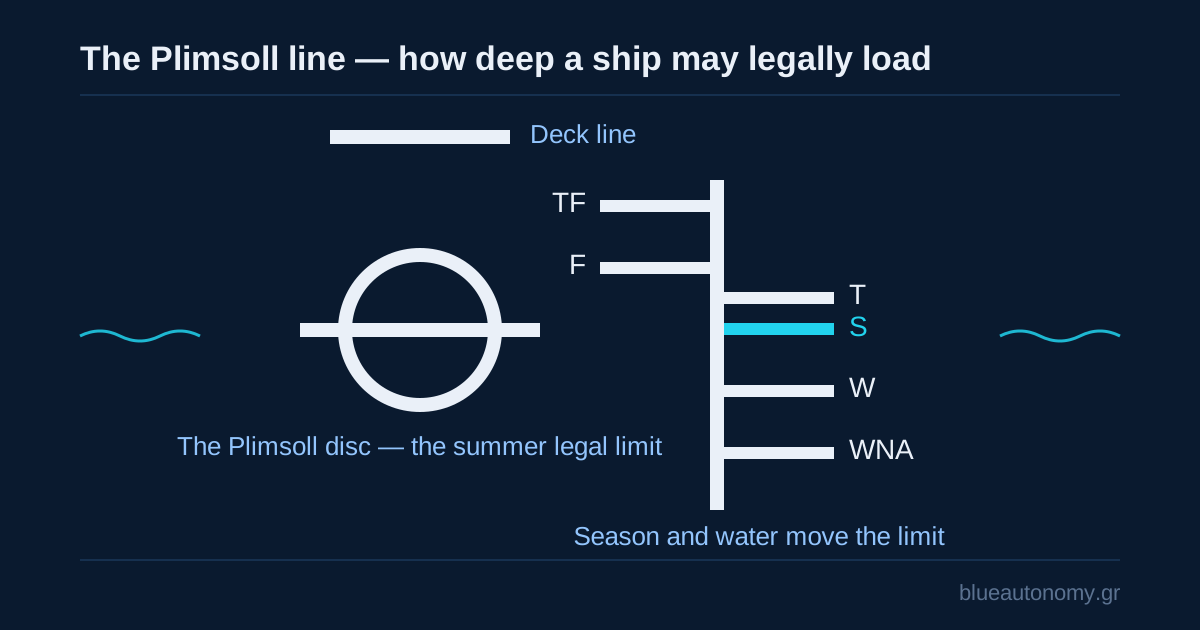
The short lines beside the circle are the clever part: the legal limit changes with the season and the water. TF tropical fresh, F fresh, T tropical, S summer, W winter, WNA winter North Atlantic. Fresh water holds a ship up less well than salt, so the same hull sits deeper in it. A winter Atlantic gives you no second chance.
And the canvas shoes the British call plimsolls? Named, it seems, after the mark. Let the water rise above the line where the rubber sole meets the canvas, and your foot is wet.
The mark is now international law, under the IMO's International Convention on Load Lines (1966). Inspectors check it on almost every merchant ship trading between countries. Draught is how deep a ship sits in the water. Every time she loads, her draught is read from the marks on her hull and checked against that circle. It is the same measurement our loading computers and monitoring systems still start from today.
Sources: Hansard, HC Deb 22 July 1875, vol 225 cc1822–9; National Museums Liverpool; S. Plimsoll, "Our Seamen: An Appeal" (1873); Merchant Shipping Act 1876, ss. 25–27, and Merchant Shipping Act 1890; IMO — International Convention on Load Lines, 1966.