Why a Ship's Speed Is Measured in Knots: Actual Knots, in a Rope
Sailors threw a piece of wood into the sea, counted the knots in the rope behind it, and timed it with an hourglass. That is why speed is in knots.
Ask anyone at sea how fast the ship is going and the answer comes in knots. Almost nobody asks: knots of what?
Actual knots. In a rope.
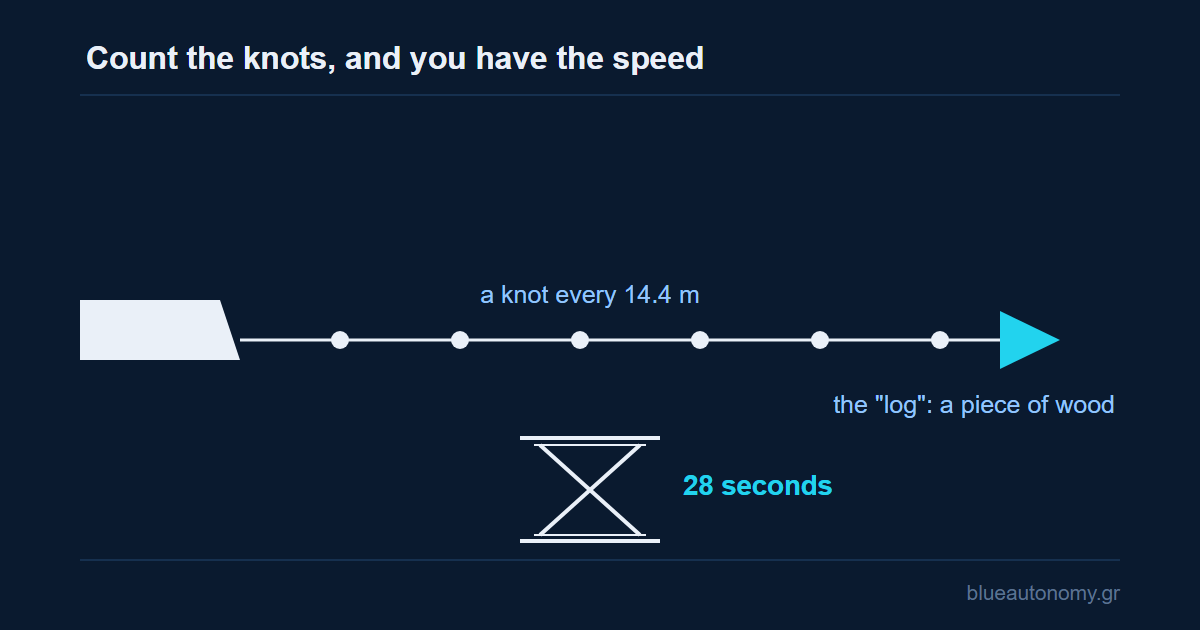
For more than three hundred years, a ship's speedometer was a piece of wood on a long rope. Sailors called the wood the log. Knots were tied along the rope at even intervals. In the version that became standard, one every 14.4 metres.
One sailor threw the log over the back of the ship, where it sat in the water like a tiny anchor. The first stretch of rope ended in a piece of cloth. It ran out freely, to get the wood clear of the rough water behind the ship. When the cloth went over the back rail, a second sailor turned a 28-second hourglass.
Then they counted the knots slipping through their fingers as the ship sailed away from the wood.
Here is the clever part. The gaps between the knots and the 28 seconds were matched on purpose. Count five knots before the sand ran out, and the ship was doing five nautical miles an hour: five knots. A nautical mile is about 1.85 kilometres. The rope did the maths. No numbers to work out on a wet deck at night.
The figures changed for a century or two. The first ropes had a knot every 42 feet, about 13 metres, and a half-minute glass. That worked because a mile was then counted as 5,000 feet: 42 feet in 30 seconds is one mile an hour. When the nautical mile was fixed at today's length, the rope and glass changed to match.
Every reading went into a book: the book of the log, the logbook. From there, a log became any record kept in order, then the log files inside a computer. So every log in on your screen carries the name of a piece of wood, first written about in 1574.
The rope is long gone. Today the number comes from GPS and sensors in the hull. Those are the same readings our performance work starts from. But the unit never changed: the sea still counts in knots.
Sources: NOAA: nautical mile and knot; Royal Museums Greenwich: log and line with its 28-second glass, first described in print by William Bourne, 1574; Shipwreck Centre & Maritime Museum on the 42-foot line and the 5,000-foot mile; Online Etymology Dictionary on log and log in.