Advancing Autonomous Navigation with AI for a Sustainable Maritime Future
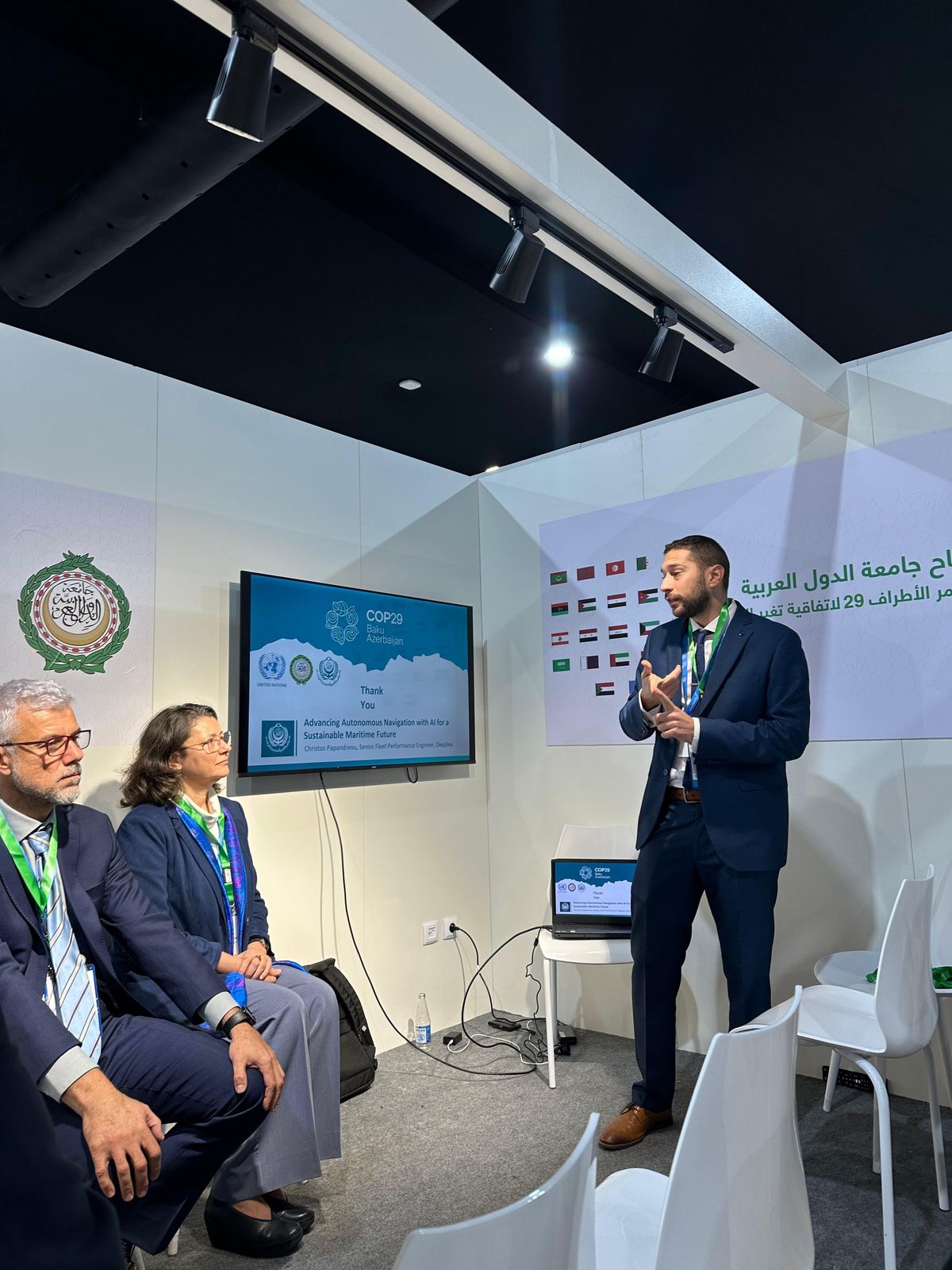
A COP29 talk on how AI and autonomous navigation are moving shipping from the 'dark ages' of vessel performance toward a measurable, incremental path to lower fuel consumption and emissions — and what it will take to reach fully autonomous, efficient sailing.
Delivered at COP29 in Baku, this talk looks at maritime decarbonisation through the lens of data: where the industry was, where it is now, and where autonomous navigation is taking it.
Yesterday: shipping in the dark
For a long time, shipping operated without the data that industries like Formula 1 or aviation take for granted — where, as Red Bull Racing's Christian Horner put it, data is the "lifeblood" of performance. Shipping was, understandably, a safety-first industry: in the face of a serious accident, burning slightly less fuel doesn't count for much. The result was limited visibility into the very systems that drive vessel performance — fuel consumption, engine power, speed, weather impact — and little high-quality, high-frequency data to improve them.
You can't improve what you can't measure
AI only became a game-changer once we could collect real-time, high-frequency data from vessels. That solved the frequency problem — but not the quality one. "Garbage in, garbage out" still holds: without strict procedures to keep data reliable and accurate, the models built on top of it can't be trusted.
Today: connected vessels, incremental gains
We can now measure vessel performance and condition accurately enough to make smarter, faster decisions. But with nearly 100,000 vessels globally and only a small fraction in the hands of pioneers, change will be incremental for most. The win is integrating an everyday-optimisation mindset across the whole fleet — retrofits, weather routing, optimal-speed operation — and building the cross-departmental performance and energy-efficiency teams that bring those gains to every single ship.
Tomorrow: top-down vs bottom-up
There are two routes to the future. The top-down route reimagines the whole vessel (think Oceanbird). The bottom-up route solves one real problem at a time and gradually automates it — much as car cruise control evolved from a simple speed-hold into near-self-driving. For the problems shipping faces today, bottom-up is the practical path: it helps not just the pioneers, but everyone else.
Our own proof of that approach is a project bringing "cruise control" to existing vessels: the system loads an optimal speed profile and instructs the main engine to follow it, removing the repetitive task of holding a target speed as conditions change. It came not from a grand idea but from a real observation — speed optimisation is a powerful, low-cost way to cut energy use, and the more accurately the speed plan is followed, the bigger the fuel saving.
The road to autonomous navigation
Fully autonomous navigation — give the ship a destination, let it plan and follow the optimal route — needs three things to come together: physics-based models that robustly predict ship dynamics; adaptability, so those models keep learning from new data as weather, currents and loading change; and obstacle avoidance for safe real-world operation. This is exactly the direction of our published work on physics-based ship-motion models and hybrid, data-tuned dynamics models, and it aligns with the IMO's developing MASS code.
What the talk covers
- Why shipping lagged other industries in data-driven performance — and why that is now changing.
- Data frequency is largely solved; data quality is the discipline that makes AI trustworthy.
- For ~100,000 vessels, incremental "bottom-up" automation beats waiting for clean-sheet ships.
- A worked example: bringing automated "cruise control" speed-keeping to existing vessels.
- The three prerequisites for autonomous navigation: physics-based models, adaptability, and obstacle avoidance.
A recorded version of this talk was given at the Digital Ship conference — watch it here.
Where it is taught. Vessel Performance Analyst I: Measuring Performance (5 courses) · Vessel Performance Analyst II: The Hull in Service (4 courses) · Ship Technology Foundations (4 courses) · Added Weather Resistance (4 courses)