Bank Effect: When the Channel Steers the Ship
Near a canal bank the bow is pushed off and the stern pulled in — a yaw moment that scales with speed squared. The physics behind the NTSB Genesis River case.
On 10 May 2019, a 754-foot LPG carrier met an inbound tanker in the Houston Ship Channel — a routine passing arrangement. Moments after the two ships cleared each other, the Genesis River sheered to port. The pilot ordered full starboard rudder. It wasn't enough. The vessel crossed the channel and struck a barge tow, spilling roughly 11,000 barrels of reformate into Galveston Bay.
The NTSB's probable cause: the hydrodynamic effects of two deep-draft vessels passing each other, combined with the ship's speed — which amplified the hydrodynamic effects of the channel banks and reduced the pilot's ability to regain control. Not equipment failure. Physics — the second of the five shallow-water effects this series maps, and the one with the most famous case file.
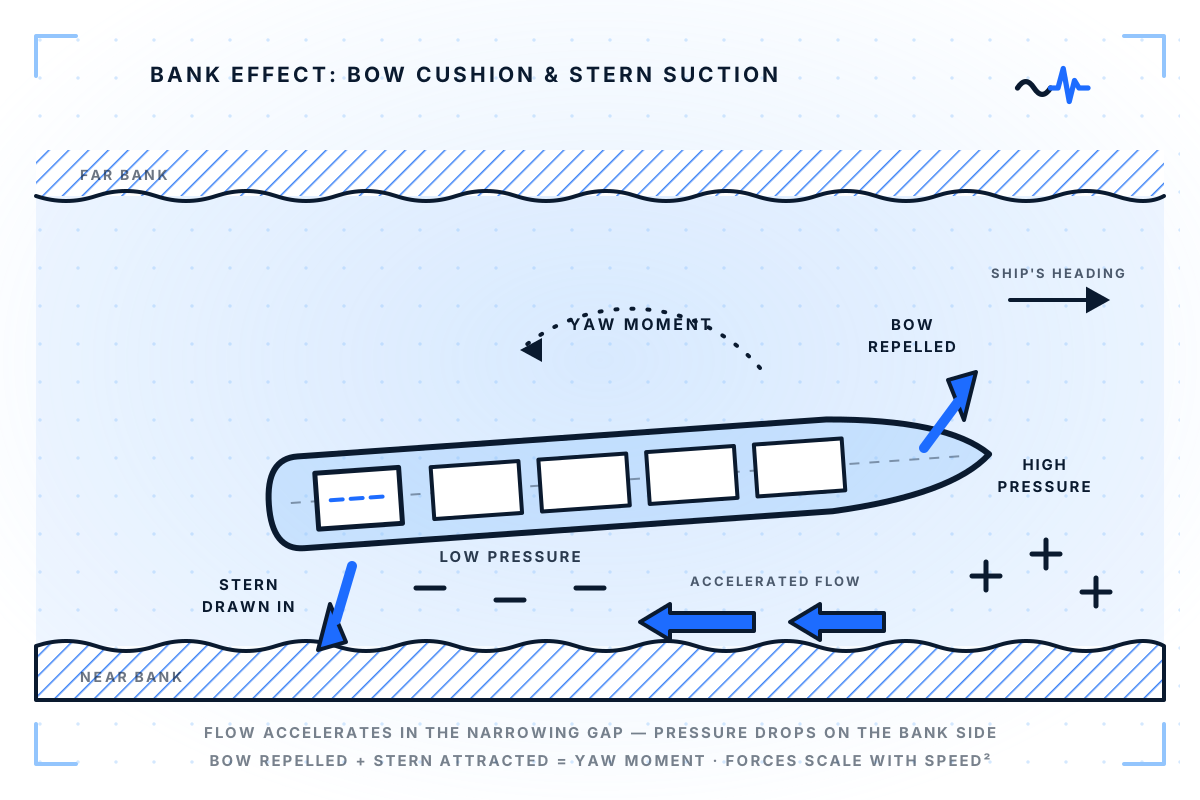
The mechanism: bow cushion, stern suction
When a vessel runs close to a channel bank or a shallow shoulder, the flow in the narrowing gap between hull and bank accelerates, and the pressure drops asymmetrically — the same continuity-and-Bernoulli argument behind squat, acting laterally instead of vertically.
The result is a force pair every pilot knows:
- Bow cushion — the high-pressure field ahead of the shoulder pushes the bow away from the bank.
- Stern suction — the accelerated, low-pressure flow along the aft body draws the stern toward it.
Together they form a yaw moment that turns the ship across the channel. Two scaling laws make it dangerous:
- The forces grow with speed squared — double the speed, quadruple the force.
- They grow sharply as lateral clearance shrinks — roughly inversely with distance to the bank.
The passing ship is a moving bank
As two vessels meet, each runs momentarily in the "bank" formed by the other's pressure field: bows repel first, then the sterns attract, a sequence of alternating yaw moments compressed into less than a minute. In open water the effect is barely noticeable. In a confined channel — where both hulls already occupy a large share of the cross-section — the passing interaction and the bank effect stack. That combination is exactly what the NTSB identified: the meeting set up the sheer, and the nearby bank amplified it.
Why couldn't full rudder correct it? At higher speed the disturbing forces grow with V², and the sheer develops faster than the vessel can answer it. The margin between controllable and uncontrollable narrows to seconds — which is why the NTSB's recommendations centred on speed, not equipment.
The performance angle
Bank effect also has a quieter, chronic cost. The asymmetric pressure field adds resistance, and the continuous helm corrections needed to hold the line through a confined transit add induced drag of their own. Confined-water legs therefore sit above the deep-water power-speed baseline for reasons that have nothing to do with hull condition — one more way waterway geometry contaminates a fouling analysis that doesn't filter for it. The inputs needed to flag these legs — position, depth, channel geometry, speed — are already in the data most fleets log.
Bank effect is not a steering issue. It is physics that needs to be quantified, not estimated.
Do you have a similar example of bank effect or passing-ship interaction taking charge of one of your vessels? I'd be curious to hear the case.