Energy-Saving Devices: Collecting the Propeller's Leftovers
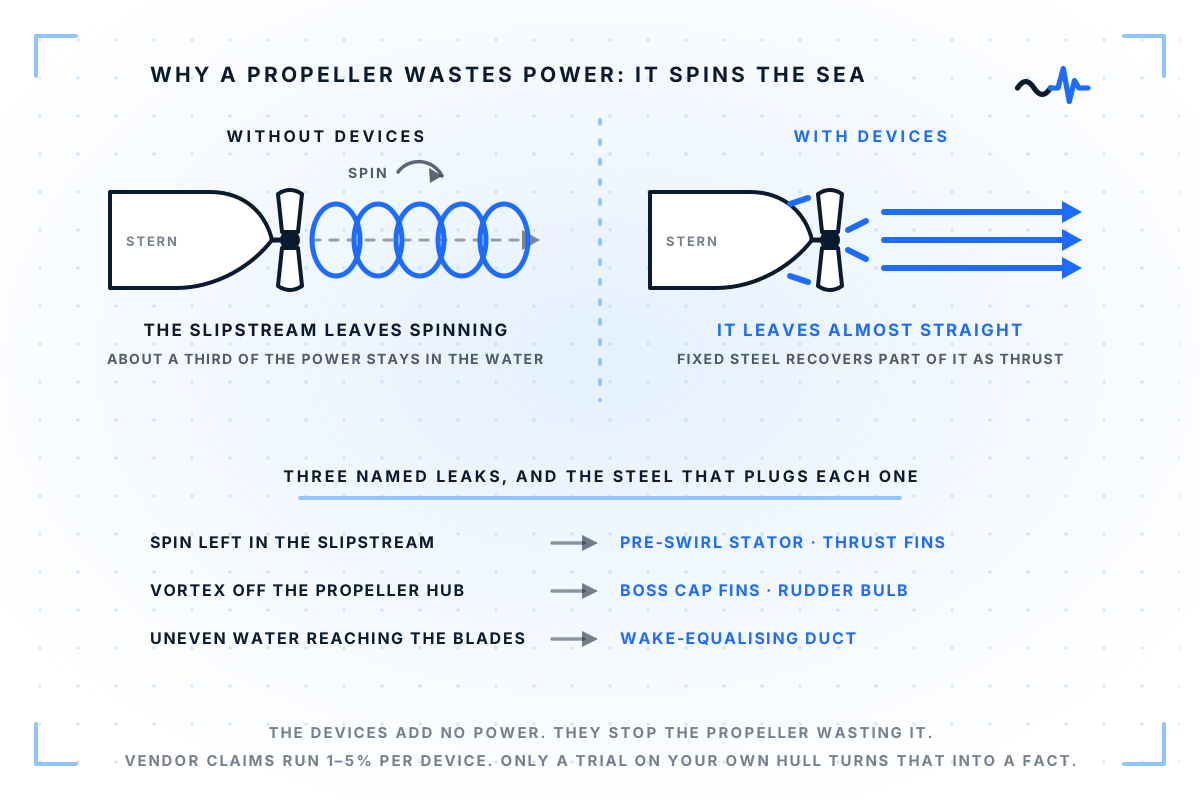
A propeller leaves a third of its power behind in the water: spin in the slipstream, a vortex off the hub, and an uneven wake. ESDs are fixed steel aimed at those named losses: 1–5% each, forever, if the device matches the hull.
A propeller converts perhaps two-thirds of the power delivered to it into useful thrust. The rest is left behind in the water, and it is left behind in three identifiable ways. The slipstream, the column of water the propeller throws astern, spins when it only needs to go backwards. A tight corkscrew of water, the hub vortex, trails off the propeller hub. And the wake, the flow the hull delivers to the propeller, is so uneven that the blades meet a different flow at every point of each revolution. That is useful for the retrofit market: three named losses, each one with a device aimed at it.
Energy-saving devices, part 4 of our energy-saving series, are narrow fixes: each one a piece of fixed geometry aimed at a single one of those losses.
Before the propeller: conditioning the inflow
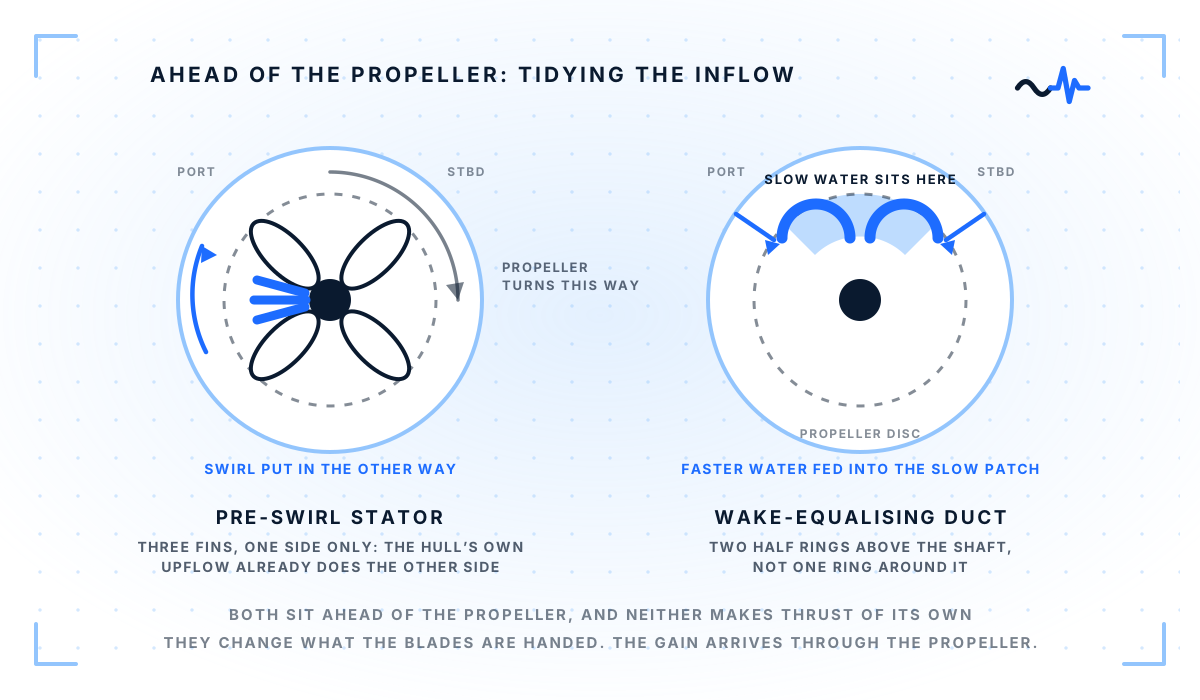
Pre-swirl stators are fixed vanes, small wing-like blades, mounted on the sternframe (the structure that carries the propeller and rudder) just ahead of the propeller. They are angled to give the inflow a rotation opposite to the propeller's, which is where the name comes from: swirl put into the water before the propeller gets it. The propeller then spends its own rotation cancelling that swirl. The slipstream leaves straighter, and energy that would have been abandoned as spin stays with the ship. The stator generates no thrust itself; it only prepares the flow.
Wake-equalising and accelerating ducts sit around the upper part of the propeller disc, the circle swept by the blade tips, where a full hull's wake is slowest and most uneven. By accelerating and smoothing that flow they hand the blades a more uniform field: better efficiency, and less of the blade-by-blade load fluctuation that drives vibration and cavitation (vapour bubbles forming and collapsing on the blades, which erodes the metal and makes noise). Integrated designs combine a duct with pre-swirl fins in one casting, attacking wake and swirl together.
Behind the propeller: recovering what escaped
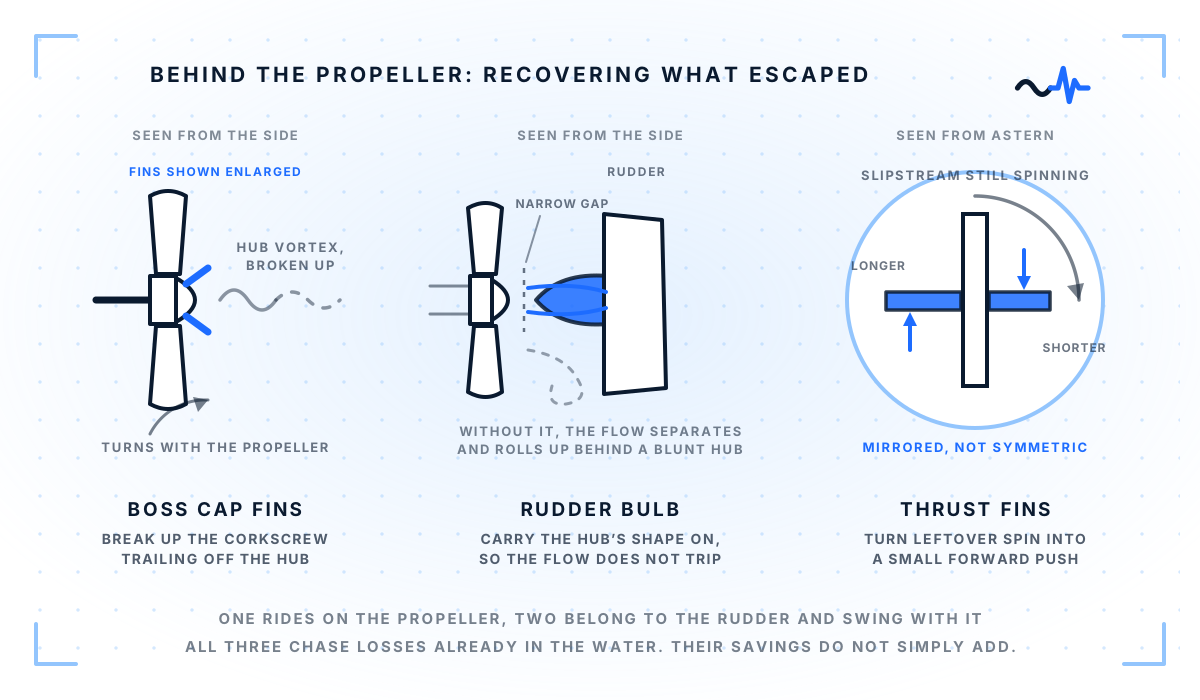
Boss cap fins are small blades on the propeller's hub cap, the cone that closes off the hub, and they break up the hub vortex: the tight corkscrew of spinning water that trails off the boss. Rudder bulbs continue the hub's shape onto the rudder, filling the gap where the flow otherwise separates and swirls. Thrust fins on the rudder recover rotational energy from the slipstream as a small forward force. Each one is a streamlining fix applied at the exact spot where the propeller leaves its mess.
Honest magnitudes and the matching exercise
Individual devices honestly deliver on the order of 1 to 5%: boss cap fins at the modest end, well-matched ducted pre-swirl systems at the top. The economics work because the price of the saving is fixed steel: no moving parts, no parasitic load, no crew workload. 3% on a ship burning 25 tonnes a day is 0.75 tonnes daily, every day, for the life of the device.
That band deserves the same caution as every other number in this series. The 1 to 5% figures come from model tests (a scale model towed in a test tank), CFD studies (computer simulations of the water flow around the hull) and vendor datasheets. They are not a measurement of your ship. An ESD is matched to one hull's wake field, so a device that earned 4% on a test case can return noticeably less, or nothing at all, on a hull it was never sized for. The honest sequence is a hull-specific prediction before the steel is ordered, then a normalised in-service comparison afterwards. Without the second half you never learn what you bought.
The catch is in the words well-matched. The gains concentrate on full-form hulls (broad and blunt) on slow ships with heavily loaded propellers, meaning propellers pushing a lot of thrust through a small disc: tankers and bulkers. That is where swirl and wake losses are largest. The same duct on a fast, fine-form (slender) hull can return nothing, or add net drag. Choosing an ESD is a matching job between device and hull, not a catalogue purchase. A serious retrofit starts from the ship's own wake field, measured or computed, and is model-tested or CFD-verified for that hull before any steel is cut, with installation timed for a scheduled dry-docking. Claims well above the honest band, or quoted without a hull form attached, get the sceptic's checklist applied hard.
The quiet dividend
There is a second benefit that costs nothing extra. Much of a ship's underwater radiated noise, the sound a ship puts into the sea and which carries for miles, comes from the same disorder that wastes energy: the hub vortex cavitates and sings, and blades passing through an uneven wake cavitate in a repeating cycle. Devices that even out the wake and dissolve the vortex cut noise and fuel with the same steel. That is worth a line in any ESD business case, as underwater noise draws growing regulatory attention.
One caution for later in the series: ESDs, wind assistance and air lubrication all change what reaches the propeller. Each claimed saving was measured alone, and they will not simply add.
Has your fleet ever fitted an ESD? Could your data say afterwards what it delivered, separately from the dry-docking it was installed at?