Wave Pattern Deformation: The Waves That Come Back
In open water a ship's waves leave forever. In a canal they reflect off the banks and return to the hull — added resistance governed by the blockage ratio.
In open water, your ship's waves radiate away and are gone forever. In a canal, they hit the bank — and come back. That return trip is the fourth of the five shallow-water effects this series maps, and it is the one that makes confined-water resistance genuinely hard to predict.
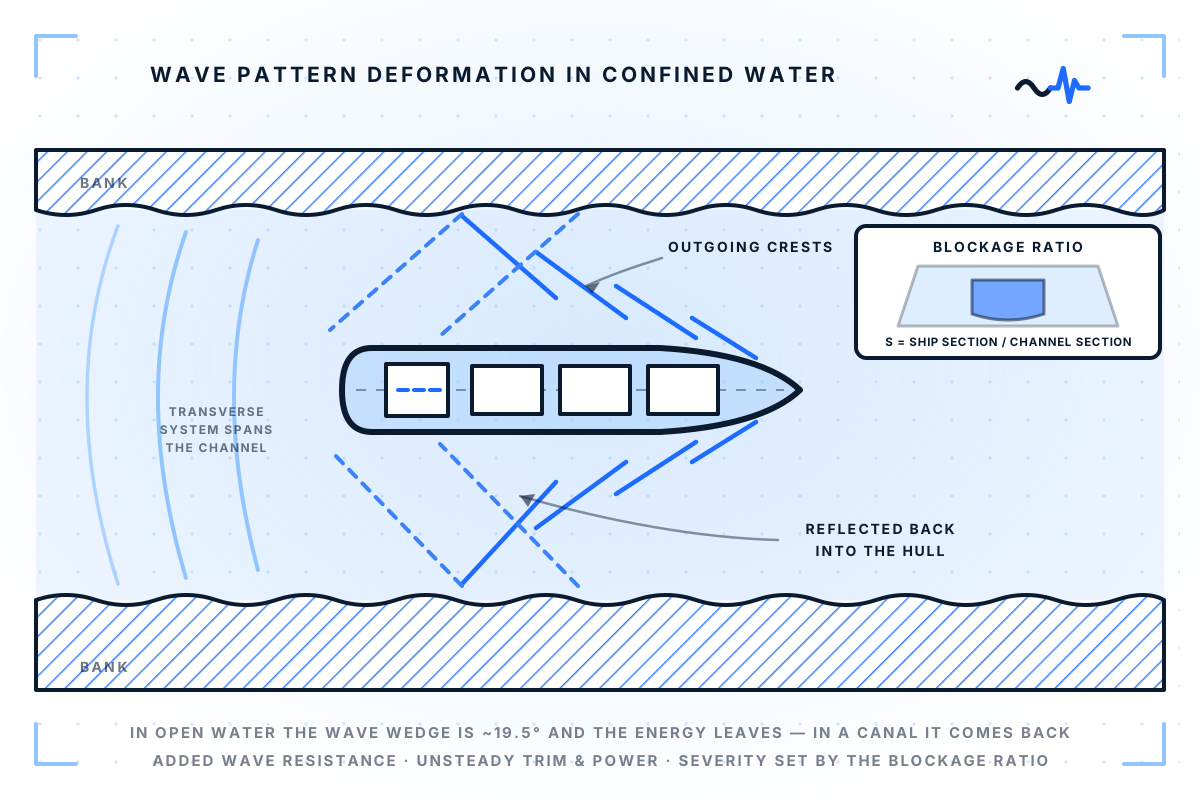
The pattern that never changes — until it does
A moving ship generates the Kelvin wave pattern: transverse and divergent waves contained in a wedge of about 19.5° on each side of the track. In deep, open water that geometry is remarkably constant — it doesn't care how big or fast the ship is. The energy spreads, disperses, and leaves.
Confinement breaks this twice.
Depth breaks the pattern. As the depth Froude number rises toward 1.0, the wedge opens up — the wave crests swing outward until, at critical speed, they stand almost perpendicular to the ship. The wave system stops trailing behind and starts travelling with the vessel — the "wall" from our critical speed post.
Width breaks the escape route. In a canal or narrow channel, the divergent waves reach the bank, reflect, and travel back across the waterway — into the hull that made them. Superimposed on this, the water squeezed aside by the hull has nowhere to go: it returns along the ship as accelerated backflow — the same mechanism behind squat — and the water level alongside physically drops. The ship sails in a moving depression of its own making.
The combined result:
- Wave-making resistance increases well beyond what any open-water model predicts.
- Trim and sinkage vary along the transit in ways calm-water models simply do not contain.
- Power fluctuates at constant RPM as reflected wave systems move in and out of phase with the hull.
What one number tells you
One parameter governs how severe all of this gets: the blockage ratio — the hull's midship cross-section divided by the channel's cross-section. Small ship, wide channel: barely measurable. Laden vessel in a restricted canal: dominant. This physics, analysed in canal hydraulics since Schijf's work in the 1940s, is part of why canal authorities set the speed limits they do.
The data point of view
For performance work, the practical point is this: canal and narrow-channel legs are structurally different data. The resistance is higher, unsteady, and geometry-driven. Averaged silently into a deep-water baseline, they read as bad hull condition. The correct treatment is to identify them — position, charted depth, and channel width are all available — and either model them or exclude them.
What ruins a fouling analysis is not the canal. It is not knowing the canal is in the data.
How does your performance analysis treat canal and narrow-channel transits — modeled, excluded, or silently averaged in?