Science Said This Wave Was Impossible. Then a Laser Measured It.
For centuries science said the sailors were exaggerating. Then, on New Year's Day 1995, a laser on a North Sea platform measured one 25.6 metres high.
For as long as ships have crossed oceans, sailors have come home with the same story. A wall of water, one huge wave, twice the size of anything else that day. It rises out of nowhere, and a minute later it is gone.
Science had an answer for those stories: the sailors were exaggerating. The old theory of the sea assumed the water was tidier than it really is. By its numbers, a wave twice the size of the waves around it was almost impossible.
Then came New Year's Day, 1995.
During a North Sea storm, a laser on a gas platform called Draupner pointed straight down at the water, measuring every wave that passed. The big waves that afternoon were about 12 metres high. That is a serious storm, but not unusual for the North Sea in winter. Then the laser recorded a single wave of 25.6 metres.
A nine-storey building, made of water, in the middle of the sea.
The platform had been built for the worst wave anyone expected in ten thousand years: about 20 metres. This one was more than five metres taller.
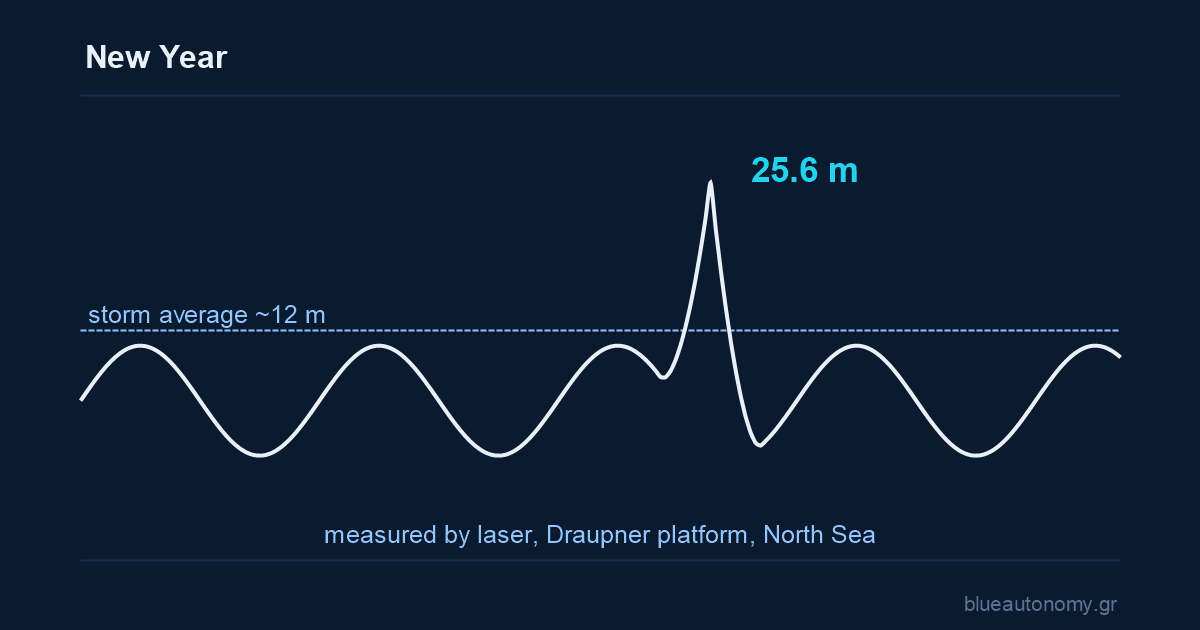
Readings like this had appeared before, and they were usually blamed on faulty equipment. Not this one. The platform's other sensors felt the same blow at the same moment. The wave also broke equipment below the deck, at a height that fitted what the laser had recorded. This time, nobody could call it a mistake.
That one measurement opened a whole field of research. Satellites scanned the oceans and found rogue waves far more often than the old theory allowed. The models changed. The rules changed more slowly, and even today most ship and platform rules do not ask a designer to plan for a rogue wave. But the company that runs Draupner wrote its own rule for one number: how high a platform's deck must sit above the water.
The people who were out there were right for centuries. They just had no laser to prove it. We listen to what the sea actually does, not to what a model says it should do. That is how we spend most of our own working days.
Sources: S. Haver (Statoil), "A possible freak wave event measured at the Draupner jacket, January 1 1995", Rogue Waves 2004 workshop, Brest; ECMWF Newsletter 148, "What conditions led to the Draupner freak wave?"; ESA, "Ship-sinking monster waves revealed by ESA satellites" (MaxWave, 2004); DNV GL Position Paper 05-2015, "Rogue waves: impact on ships and offshore structures".