Why Ship Windows Are Round, and Why the First Jet Airliner Broke Apart
A sharp corner is where the force inside metal gathers and cracks begin. That is why ship windows are round, and why the first jet airliner broke apart in 1954.
Look at an old ship and you will see them: small round windows all the way down the hull. Not oval, not square. Round. It is one of the oldest tricks at sea, and the reason for it is invisible.
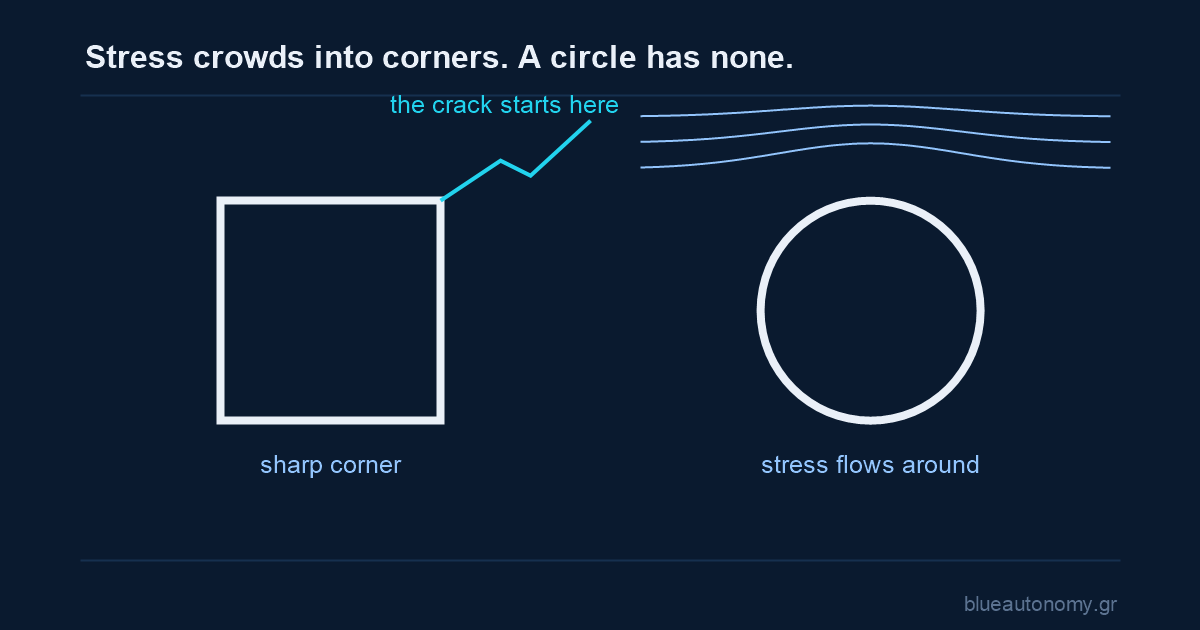
A hull at sea is pushed, twisted and bent all day, every day. That sets up a pulling force inside the steel plates. Engineers call it stress, and it does not spread evenly. It gathers in the corners. The sharper the corner, the more of it gathers there. The crowding has a name: stress concentration. So a sharp corner is where a crack is born.
A circle has no corners. Cut a round hole in a steel plate that is being pulled. The force at the hole's edge still rises, to about three times what it is elsewhere. But that is as far as it goes. Sharpen the hole into a corner and there is no limit: the tighter the corner, the higher the force climbs.
Shipbuilders chose the round porthole long before anyone could work out why. It was the easiest shape to clamp shut against the sea, and the kindest to the steel around it. The calculations came much later. They said the shipbuilders had been right.
Aviation learned the same lesson, and the price was high. In 1954 the world's first jet airliner, the de Havilland Comet, broke apart in the air twice within months. Investigators sank a whole fuselage, the body of the plane, in a water tank. They pressurised it again and again until it burst. They traced it to metal fatigue, starting in the corners of openings cut into the skin. Fatigue is the slow cracking that repeated bending causes.
The story is usually told about the passenger windows. It was not them. On the first aircraft the crack began in the cabin roof, at a rivet hole in the corner of a small panel. Rivets are the metal pins that hold the plane's skin together. Either way the lesson holds. A corner is where a structure begins to tear.
Every jet you have ever boarded carries that lesson. The openings cut into its cabin have wide, rounded corners, windows included. Look at them next time you fly. Ships knew that curve first.
Structures fail at the small details, and the failure begins long before anyone can see it. That is why so much of modern engineering, ours included, is about measuring what the eye cannot catch.
Sources: "Report of the Court of Inquiry into the Accidents to Comet G-ALYP on 10 January 1954 and Comet G-ALYY on 8 April 1954" (Lord Cohen, HMSO, 1955); Royal Aircraft Establishment, "Report on Comet Accident Investigation", Accident Report 270 (Ministry of Supply, 1954); P. A. Withey, "Fatigue failure of the de Havilland Comet I", Engineering Failure Analysis 4(2), 1997; Kirsch (1898) and Inglis (1913) on stress around holes and sharp corners (any strength-of-materials text, e.g. Timoshenko, covers both).