The Other Half of the Fuel: Machinery, Waste Heat and the Plug on the Quay
Even a modern two-stroke main engine turns only about half the fuel's energy into shaft work, the power that reaches the propeller. Machinery measures catch the rest (shaft generators, waste-heat recovery, the cube law on pumps and fans), and shore power takes over when the ship stops.
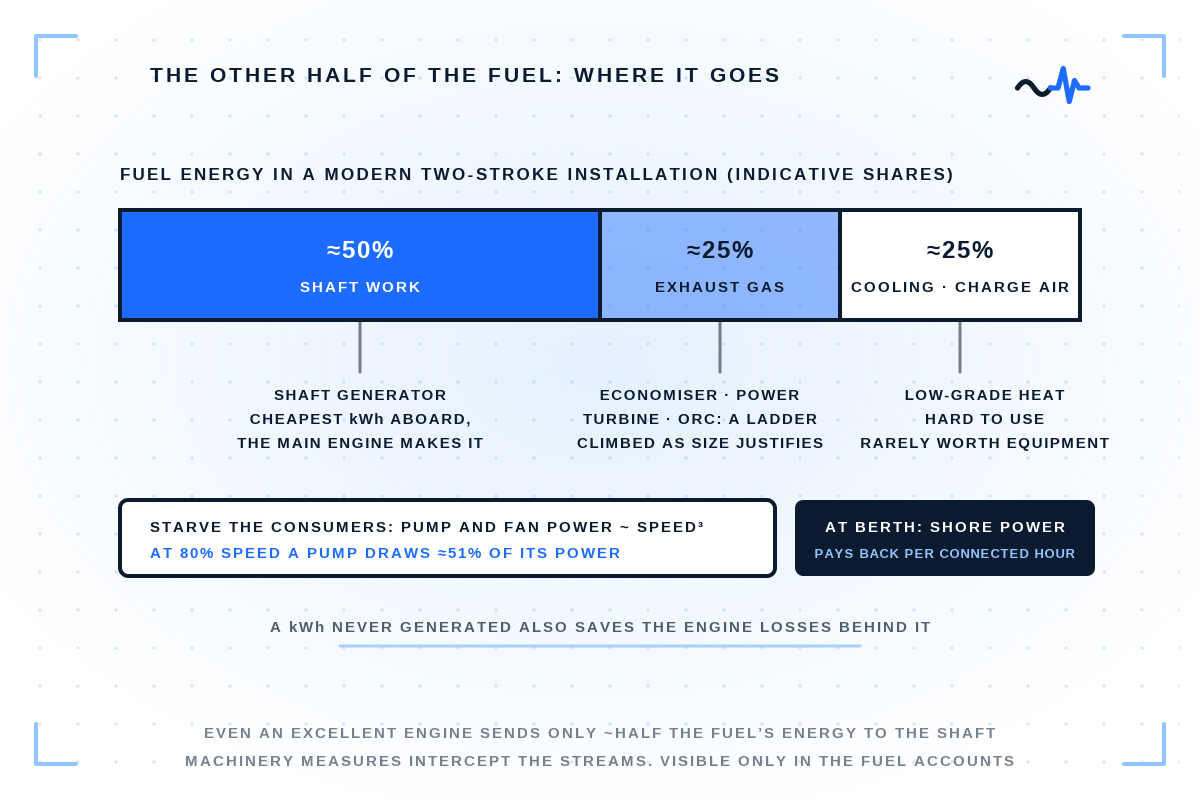
The hull articles in this series chased resistance. This one goes inside, where the losses are larger and quieter. A modern two-stroke diesel, the slow-turning main engine that drives the propeller directly, is among the most efficient heat engines ever built. Even so, it converts only about half of the fuel's energy into shaft work, the useful power that actually turns the propeller shaft. The other half leaves as heat: roughly a quarter through the funnel as hot exhaust, and most of the rest through the cooling water and the charge-air coolers, the heat exchangers that cool the compressed air on its way into the cylinders.
Part 5 of our energy-saving series: the machinery and waste-heat family, which is about catching those streams before they are lost, plus the one measure that works when the ship stands still.
Make electricity where it is cheapest
A ship at sea usually runs auxiliary diesels, the small generator engines, for electrical power while the main engine, a more efficient machine, turns the propeller beside them. A shaft generator is a generator driven by the main engine's own shaft, so the ship makes its electricity there instead. The electricity still has to be made; the saving is the efficiency gap, because the main engine produces a kilowatt-hour with fewer grams of fuel than the auxiliaries it displaces. Older installations had a catch: shipboard electricity must hold a steady frequency, so the shaft had to spin at constant speed. Modern power electronics, in the form of frequency converters, removed that constraint. That is what made shaft generators standard on newbuildings and a common retrofit. The auxiliaries become what they should be: port and standby machines.
Recover the heat before it leaves
Waste-heat recovery is a ladder, climbed as far as the installation's size justifies. The first rung is on almost every ship: the exhaust-gas economiser, a heat exchanger in the funnel that boils water into steam using exhaust heat. That steam heats the fuel and serves the hotel services, meaning the domestic side of the ship such as accommodation heating, hot water and the galley. Without it, that heat would come from burning more fuel in a boiler. Larger plants climb higher: a power turbine, a small turbine spun by exhaust gas to drive a generator, or an organic Rankine cycle plant, which uses a fluid that boils at low temperature and so can work on heat too cool for steam. Both turn heat directly into electricity. Each rung adds equipment and maintenance, which is why the case strengthens with engine size and hours at sea.
The engine itself belongs in this family too. Tuning injection and turbocharging for the load range the ship actually sails, rather than the design point she rarely visits, claws back fuel with no new hardware at all.
Starve the consumers
Ships are full of pumps and fans sized for the worst case (tropical cooling water, full engine load) and run flat out regardless, the surplus throttled away by valves and dampers. That is driving with the brakes on. The affinity laws, the rule that a pump's or fan's power rises with the cube of speed, make the fix dramatic: a pump slowed to 80% speed draws about 51% of its full-speed power. Variable-speed drives, which let a motor run at the speed actually needed instead of full out, routinely halve those loads on engine-room fans and cooling pumps.
Saving electricity counts twice. A kilowatt-hour saved never had to be generated, so the ship also keeps the generator and engine losses that would have stood behind it. Several kilowatt-hours of fuel energy stay in the tank for each one trimmed from the switchboard.
The plug on the quay
Then the ship stops and becomes a floating power station, auxiliaries running around the clock a few hundred metres from apartment windows. Port stays account for roughly 7% of shipping's greenhouse-gas emissions, which is why port cities regulated the berth before global rules reached the ocean. Shore power replaces the running diesels with a cable from the quay: megawatts at high voltage, converted between grid and ship frequencies. Before any load transfers, the two supplies must be synchronised in voltage, frequency and phase, matched closely enough that they act as one system. The IEC/IEEE 80005 series is the international standard for these connections, so that ship and shore equipment built oceans apart mate safely.
For the owner the sum is simple: the retrofit pays back per connected hour, so what decides it is where the ship trades rather than the technology. A ferry or liner vessel, one that runs a published schedule on a fixed route, calls repeatedly at equipped berths and connects thousands of hours a year, and the case can be strong even before mandates. A tramp bulker, which goes wherever the next cargo is, may carry the equipment for years between compatible quays. In Europe the direction is fixed in law: from 2030, container and passenger ships over 5,000 GT (gross tonnage, a measure of a ship's size) must use shore power at major ports, with the ports obliged to provide it. Where mandates do not decide, the port's tariff belongs in the spreadsheet next to the fuel price.
Almost everything in this article is invisible from the pier. It shows up in one place only: the fuel accounts.
Do you know what your auxiliaries burn at berth, and what the same hours would cost through a cable?
Go further at the Blue Autonomy Academy: lessons 6 and 7 of the free course Energy-Saving Technologies cover machinery measures, waste-heat recovery and shore power, and The Other Engines: Diesel Generators and the Electrical Load works through the shaft-generator decision and the port stay in detail.
Where it is taught. Vessel Performance Analyst I: Measuring Performance (5 courses) · Vessel Performance Analyst II: The Hull in Service (4 courses) · Ship Technology Foundations (4 courses) · Added Weather Resistance (4 courses)