Mud and Silt: The Seabed That Moves
Fluid mud recreates Nansen's dead-water mystery in modern ports: internal waves, yield-stress drag, and a seabed defined by density, not the echo sounder.
In 1893, Fridtjof Nansen's ship Fram hit something invisible off the Siberian coast. Her speed collapsed from four and a half knots to barely one. Engine fine. Hull fine. Sea flat calm. The crew called it dead water, and for years nobody could explain it.
This is the fifth and final of the shallow-water effects our series maps — and the strangest.
The ship that got stuck in nothing
The answer came from a young Vagn Walfrid Ekman in 1904: a thin layer of fresh meltwater was sitting on top of the heavier salt water, and the Fram's energy was going into generating waves — not on the surface, but on the invisible interface between the two layers. The ship was towing a wave system nobody could see.
Here is the fun part: your vessels may be doing the same thing today, in some of the busiest ports in the world.
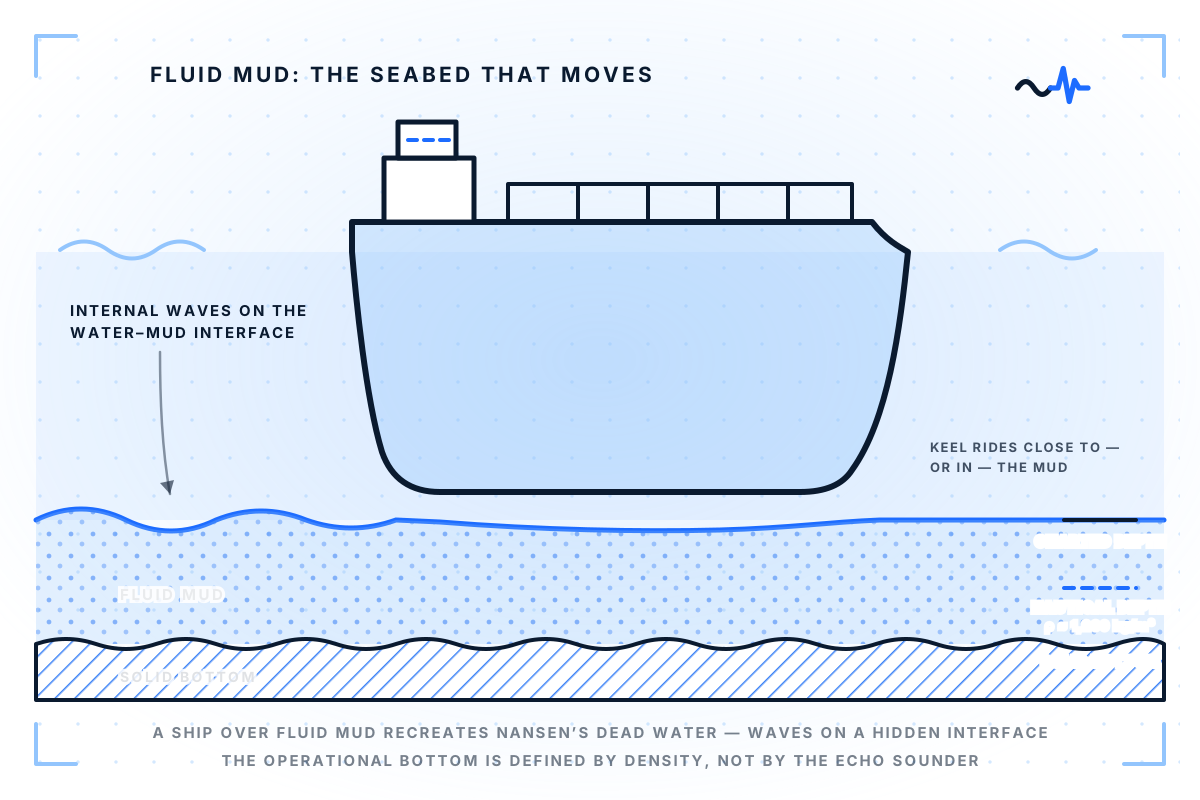
The seabed that isn't where the chart says
In ports and estuaries like Rotterdam, Zeebrugge, or the river approaches of South America and Asia, the "seabed" is not where the chart says it is. Above the solid bottom sits a layer of fluid mud — suspended sediment with a density between water and soil, sometimes metres thick. A dual-frequency echo sounder famously shows two bottoms: the high frequency bounces off the top of the mud, the low frequency finds the hard ground below.
Sailing in yogurt
Sail close over that layer and you recreate Nansen's problem: internal waves form on the water–mud interface, adding a resistance component that no standard shallow-water correction contains. Touch the layer, and things get stranger — fluid mud is a yield-stress material. It behaves less like water and more like yogurt: it refuses to flow until pushed hard enough, then drags on the hull viscously.
Nautical depth: permission to touch
Which is why the world's mud ports invented one of the most delightfully pragmatic concepts in navigation: nautical depth. The operational bottom is defined not by the echo sounder but by density — commonly around 1,200 kg/m³. Below charted depth, above solid ground, there is a zone where your keel is officially allowed to be inside the seabed. Some of the largest vessels afloat routinely sail with their keel in the mud, on purpose, with the port's blessing.
The five effects, complete
For performance data, the message is simple: a muddy port approach is neither open water nor solid-bottom shallow water. It is a third thing, and it adds drag that will never appear in a weather correction. Worth knowing which of your data points were collected in yogurt.
That closes the series: squat, bank effect, critical speed, wave pattern deformation — and the seabed that moves. Next up: a deep dive into ISO 19030, the standard for measuring what all five of these effects try to hide.
Have you ever seen unexplained speed loss in a muddy port approach — and did anyone on board believe the mud did it?